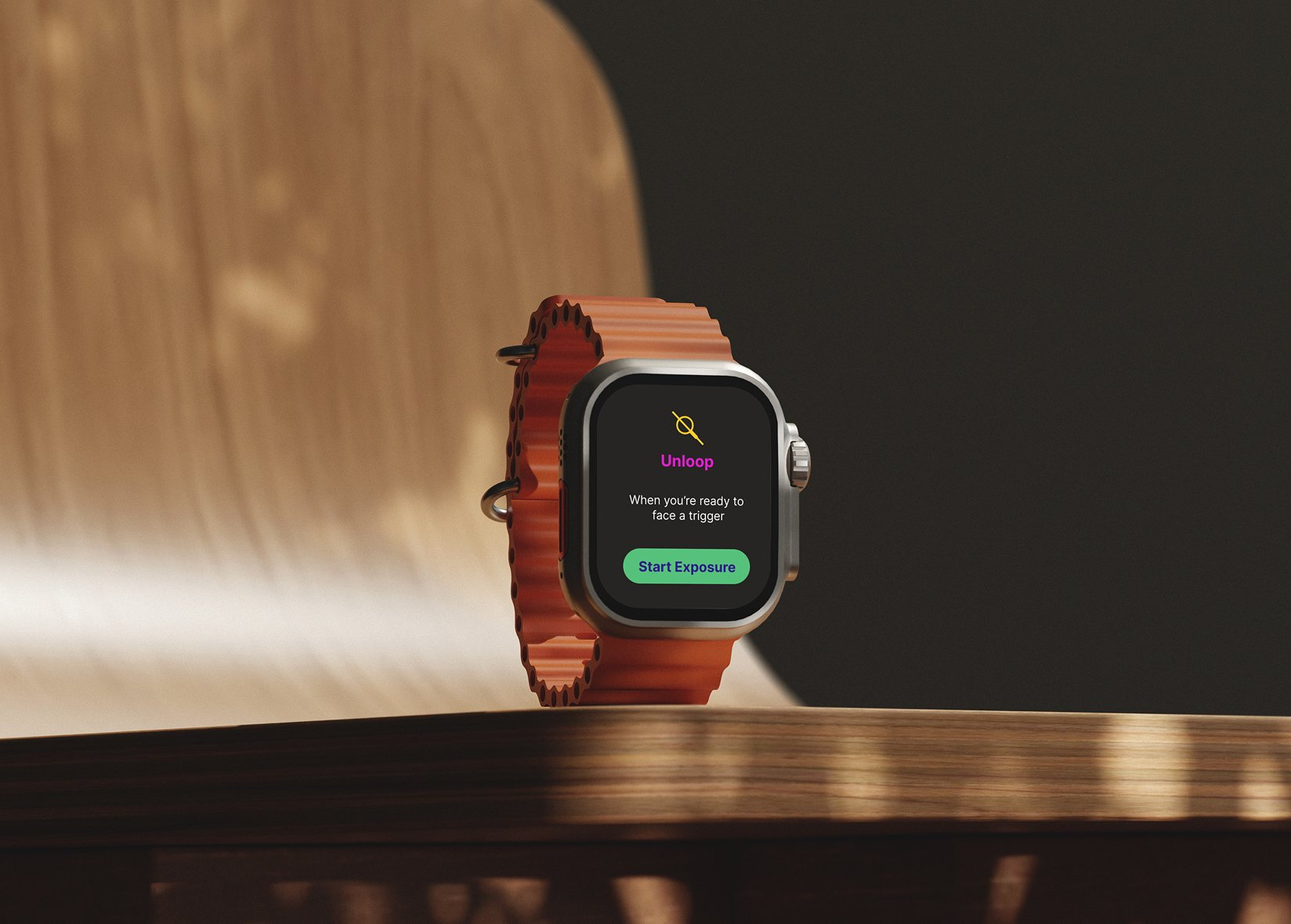
A smartwatch and companion-app concept that helps people with contamination OCD stay in the hardest moment, the urge to wash, instead of escaping it. Unloop brings Exposure and Response Prevention out of the clinic and into the everyday situations where it is actually needed.
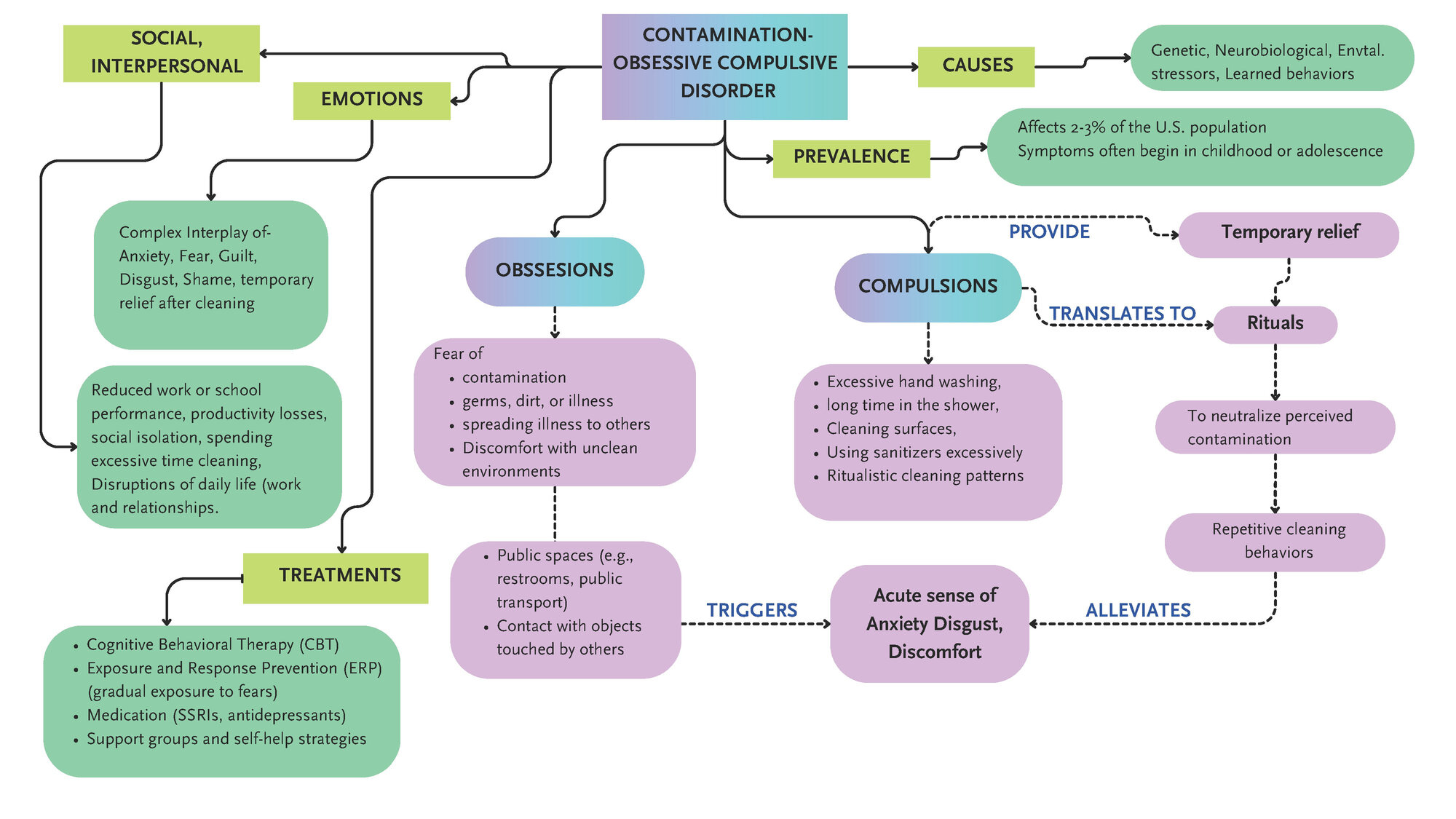
A concept map I built to make sense of contamination OCD — its emotional and social dimensions, the obsession–compulsion–relief loop, and where treatment (CBT and ERP) fits.
The Problem
Contamination OCD runs on a loop: an intrusive thought ("this is contaminated") triggers anxiety, a compulsion (washing, sanitizing, avoiding) brings brief relief — and that relief is the trap, teaching the brain the ritual keeps it safe, so the loop returns stronger each time.
The gold-standard treatment, Exposure and Response Prevention (ERP), breaks the loop by facing the trigger, resisting the compulsion, and staying with the anxiety until it fades on its own. It works — but it's largely clinic-bound, while the hardest moments happen in real life, with no therapist in the room.
Research Insight
Reviewing the clinical literature surfaced a finding that became the spine of the project: people with OCD experience a deep distrust of their own memory, perception, and attention. The disorder isn't only about germs, it's about not being able to trust your own read of reality.
That reframed the brief. A useful tool here couldn't just manage symptoms or make anxiety go away. It had to rebuild self-trust, not hand the person a new external authority to lean on. As I would learn, that distinction is exactly where my first design went wrong.
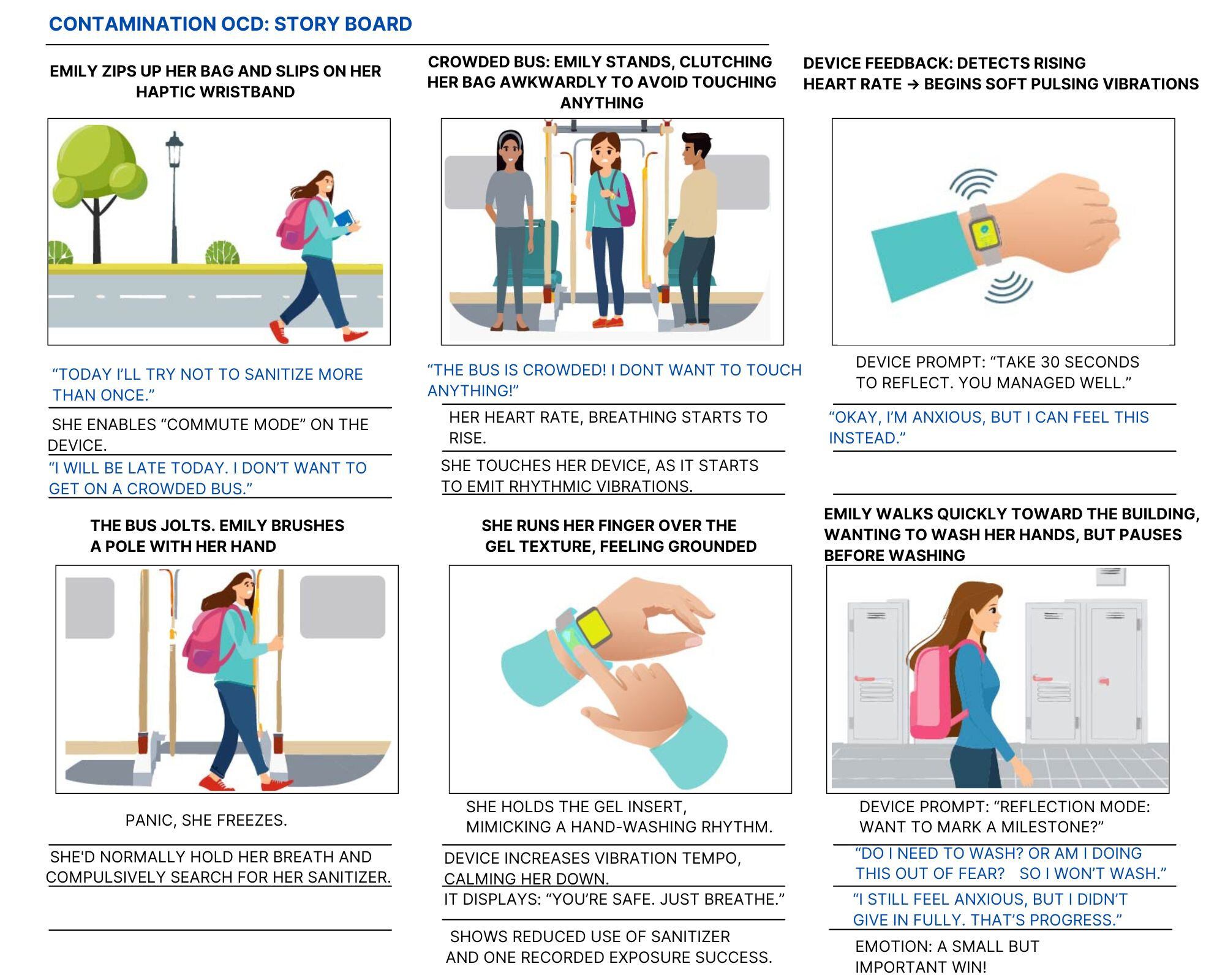
A storyboard mapping Emily's commute and the in-between moment Unloop is designed for — the urge to wash after an unavoidable trigger.
The Scenario
To ground the design in a real situation, I storyboarded the daily commute of Emily, a graduate student with contamination OCD who rides a crowded bus to campus. The storyboard locates the exact moment a tool could intervene, the seconds after she brushes a pole on a jolting bus, when she would normally freeze and reach for her sanitizer. That in-between moment, away from any clinic, became the design target.
Iteration 1
My first concept was a haptic wristband that detected anxiety and soothed it. It auto-triggered an "Anxiety Detected" alert from heart rate, reassured the user with "You're safe. Just breathe," offered a textured gel insert to rub in a hand-washing rhythm, and used calming vibrations to bring anxiety down.
It looked caring. Tested against the research, it was working against itself.
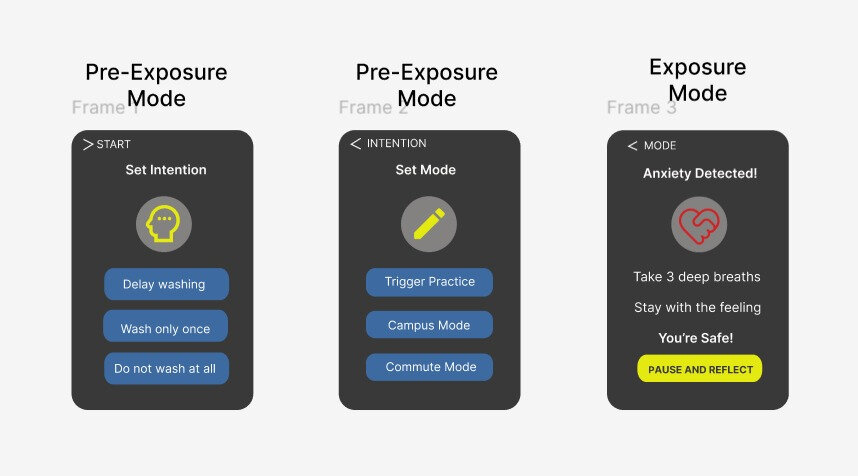
Pre-exposure & exposure modes: Set Intention → Set Mode → an "Anxiety Detected" screen that reassured "You're Safe."
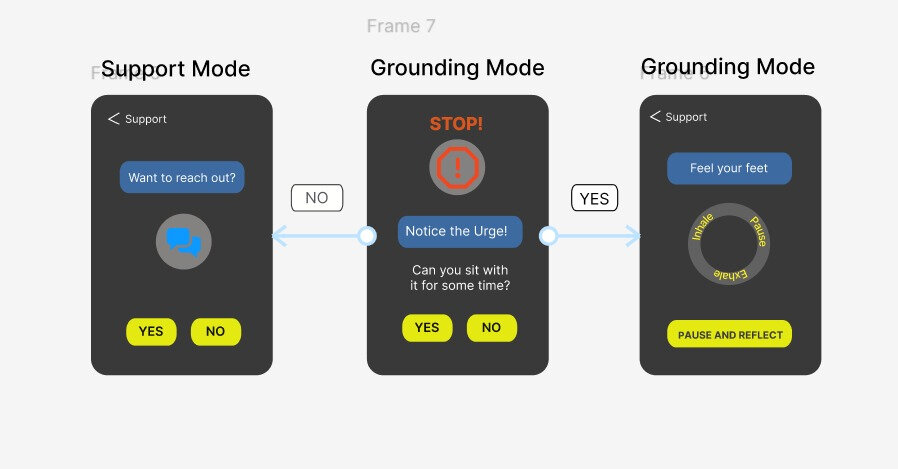
Support & Grounding modes: a "Notice the Urge" stop screen, a breathing exercise, and an option to reach out.
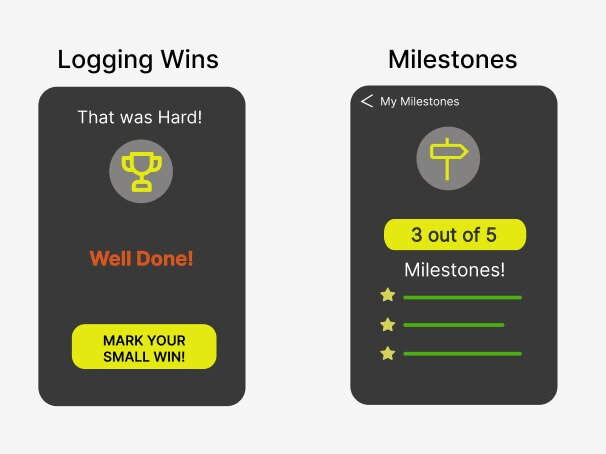
Progress & reflection: logging a "small win" after a hard moment, and a milestones tracker.
Why it was wrong:
The Pivot
The redesign flipped Unloop's job. Instead of helping the user escape discomfort, it helps her stay in it — and then shows her what she learned.
| Before | After | |
|---|---|---|
| Trigger | Device auto-detects anxiety | User chooses to start an exposure |
| Core message | "You're safe" (reassurance) | "You don't know for sure — and you're staying anyway" (willingness) |
| Grounding | To make anxiety go away | To help her stay in it longer |
| Tactility | Gel ritual + soothing buzz | One discrete cue; no soothing rhythm |
| Proof | Device asserts she's okay | Her own logged data shows it |
| Long-term | Ongoing reliance | Built-in fading — the device prompts less over time |
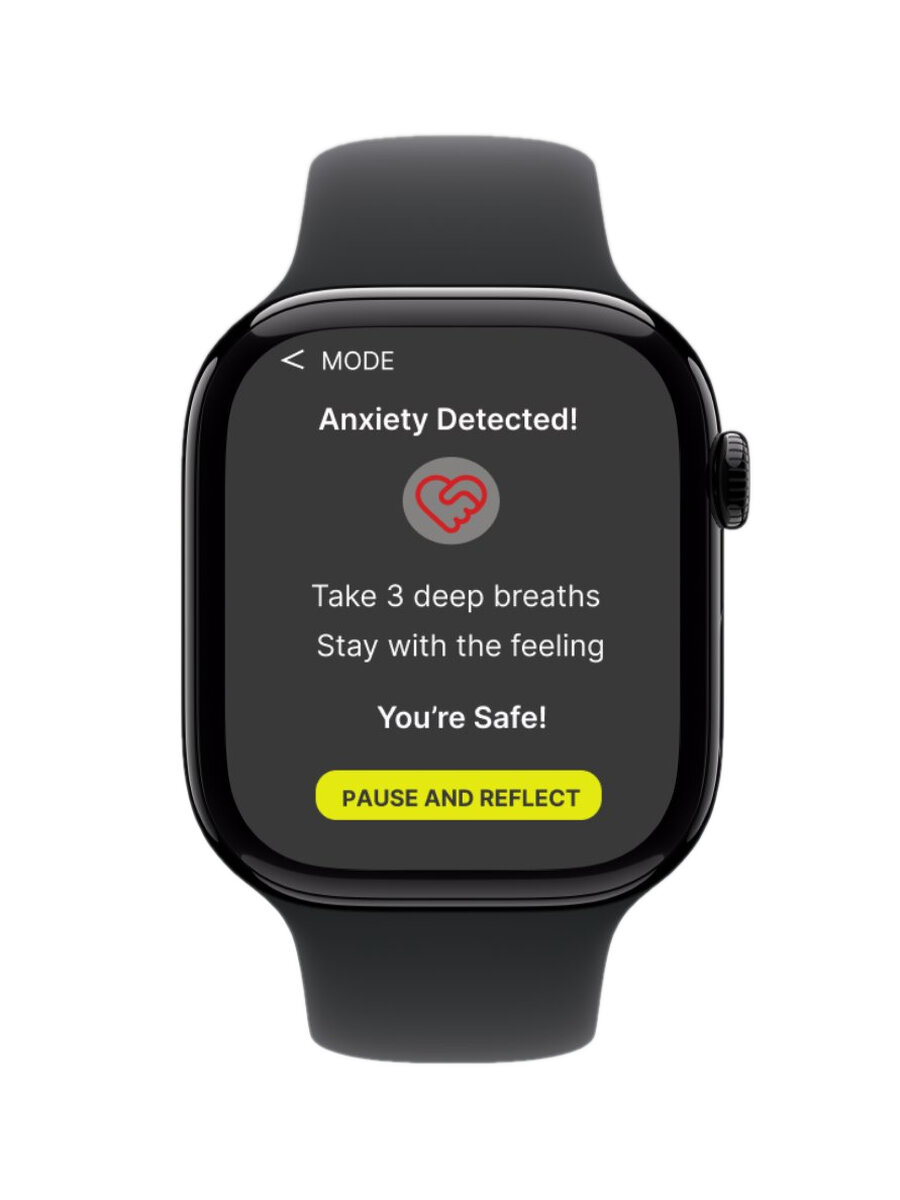
Before: During Exposure Mode — while the device detects, reassures, and answers the OCD question.
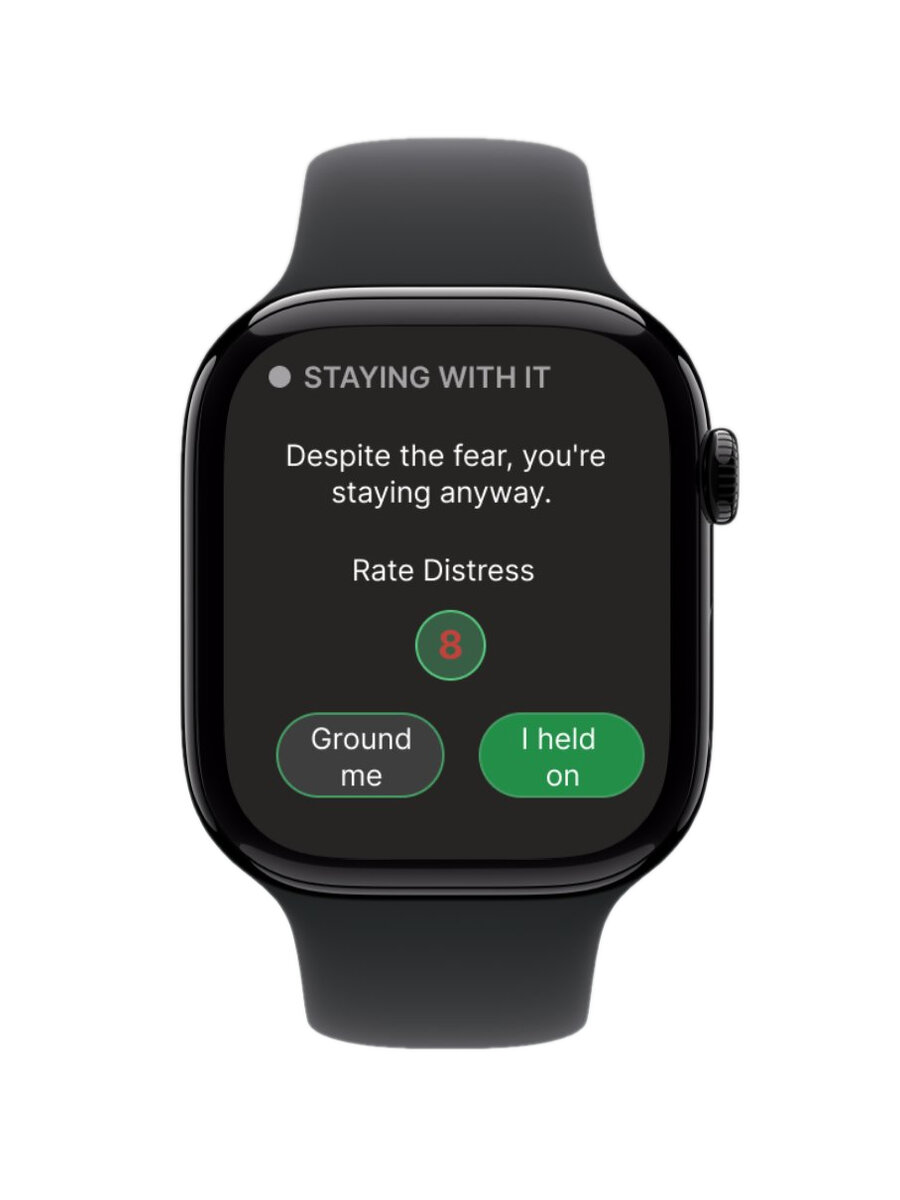
After: During Willingness + Dial — while the user starts the exposure, holds the uncertainty, and rates her own distress.
The Solution, On the Wrist
One idea, one action per screen — sized for the 30 seconds when bandwidth is lowest. The flow walks Emily from intention to evidence:
She begins on her own terms, then picks an ERP level: delay washing, wash once, or not at all.
She names her feared outcome and how strongly she believes it — a prediction to test.
Willingness, not reassurance. "I held on" is the primary action; grounding appears only if asked, to stay in the feeling.
She checks the prediction against what happened, then logs the win — distress down, no ritual.
As tolerance grows, the device prompts less and says so. Its goal is to become unnecessary.
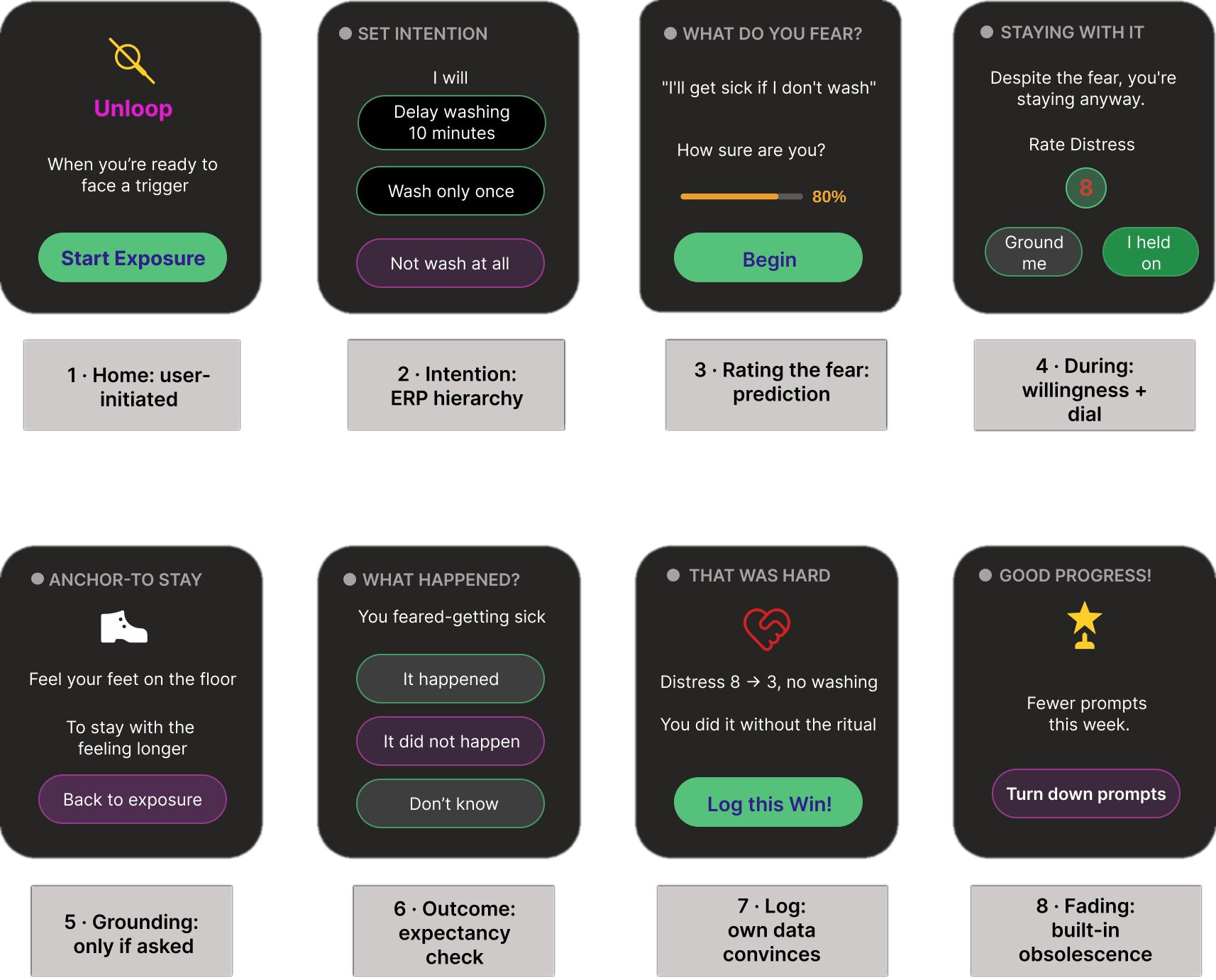
The redesigned watch flow, eight glanceable screens from Start Exposure to a built-in fading mechanic.
The Solution, On the Phone
The reflective work, the part that benefits from a bigger screen and a calmer moment, lives in a companion app. Crucially, none of these screens tell Emily anything. They show her what she did and what happened, and let her draw the conclusion.
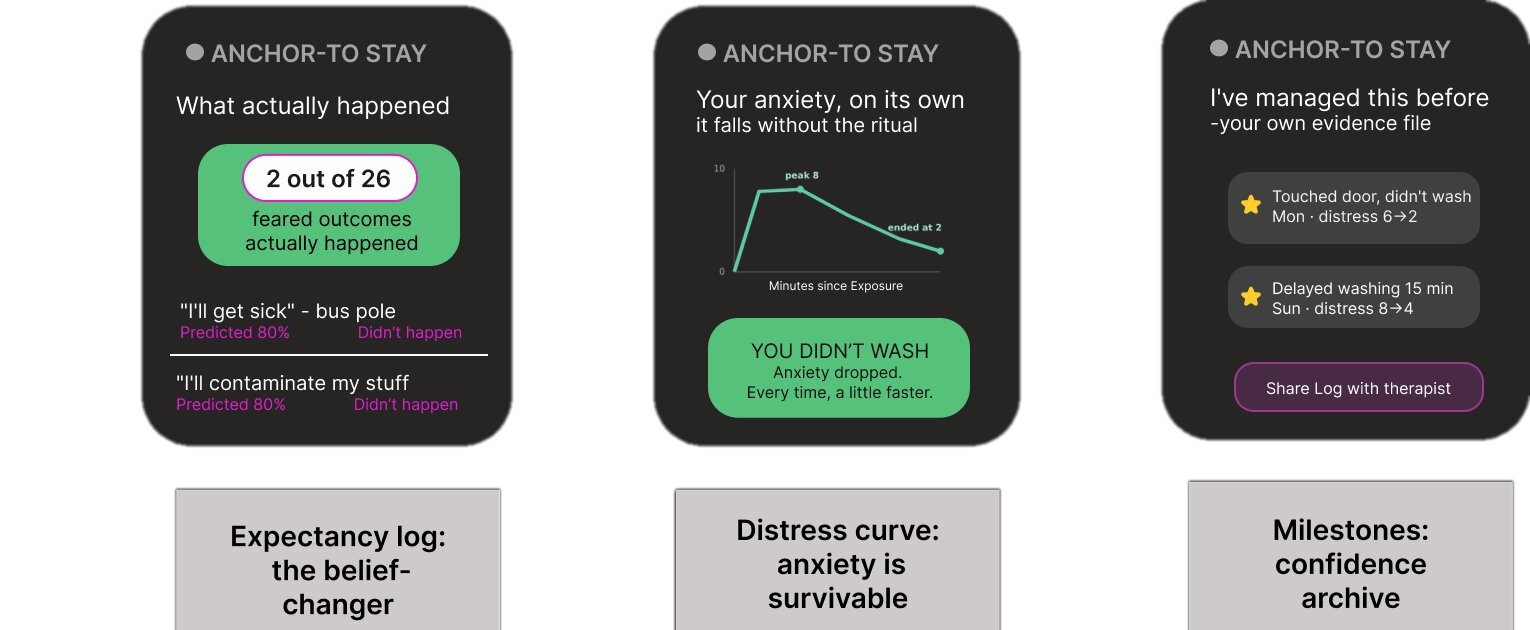
The companion app, an expectancy log, a distress curve, and a milestones archive.
Prototype
I built an interactive prototype in Figma on an Apple Watch frame, wiring the full exposure flow with Smart Animate, the distress dial counting down, the confidence rating filling, selected button states, and the branch between "it happened" and "it didn't." The animated distress drop is the emotional core: anxiety falling on screen, without the ritual.
The interactive prototype, recorded from the Figma build.
Reflection & Limitations
Unloop is a concept, and naming its boundaries is part of designing responsibly in a clinical space. It is a between-session companion to clinician-guided ERP, not a standalone treatment. Its therapeutic framing is grounded in the inhibitory-learning model of ERP, but the specific implementation would need validation with an OCD specialist and people with lived experience before any claim of efficacy.
The biggest thing I learned: in mental-health design, the most intuitive, comforting solution can be the harmful one. Good intentions aren't enough, the design has to be checked against how the disorder actually works. Catching and reversing my own first instinct was the real work of this project.
Future Vision