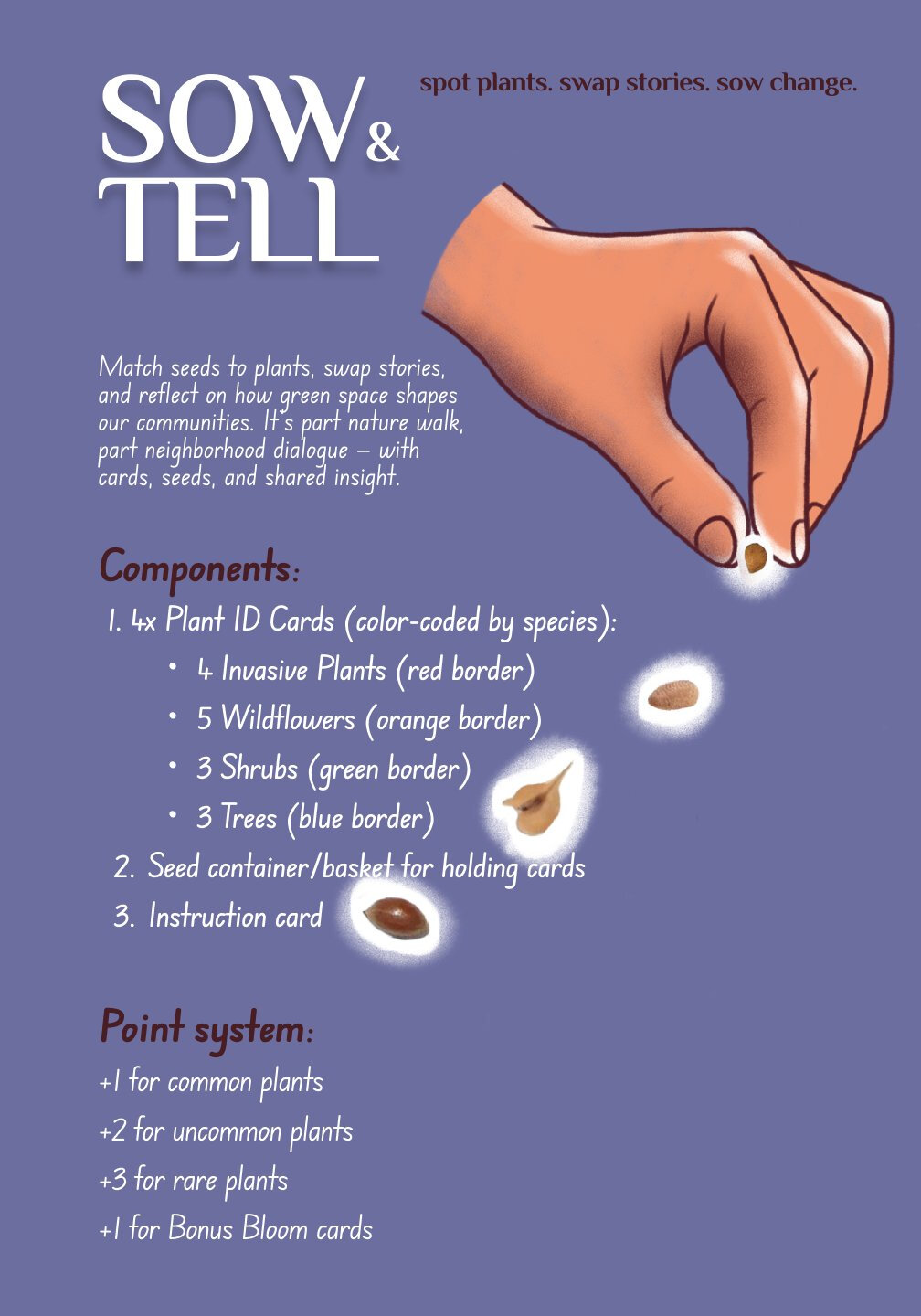
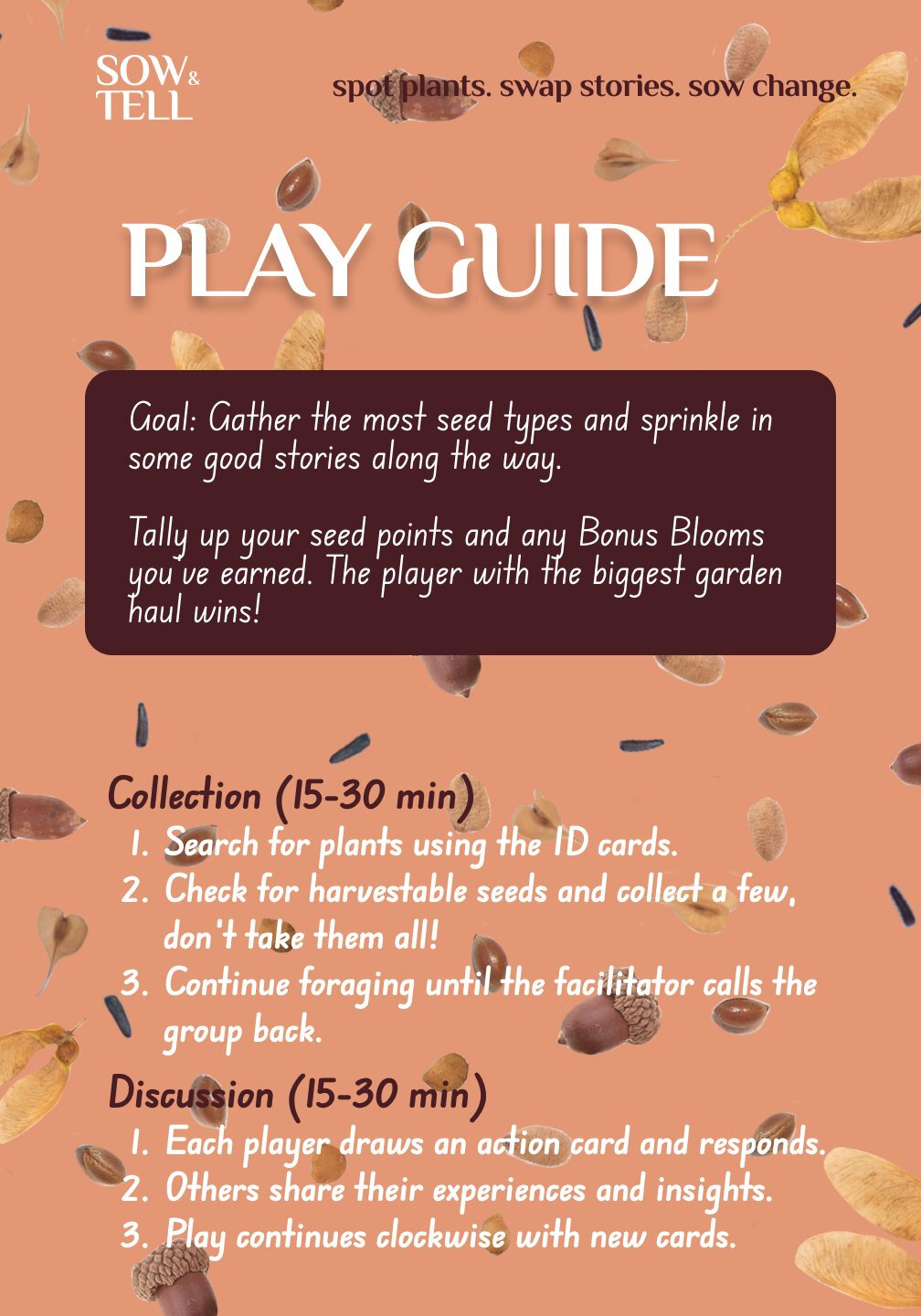
Sow & Tell is a seed collection conversation toolkit that uses native and invasive plant identification as an accessible doorway into deeper civic dialogue on green space, displacement, and belonging in Boston neighborhoods.
The Problem
In Boston neighborhoods like Dorchester, green-space development and gentrification are deeply intertwined. New parks and "improvements" can raise property values and accelerate displacement of long-time residents. The young people most affected are rarely included in civic conversations about these changes.
Our partner, Civic Data Theatre Collaborative, asked our team to design a participatory framework that could generate qualitative, art-space-compatible data, material that could inform policy.
The Process
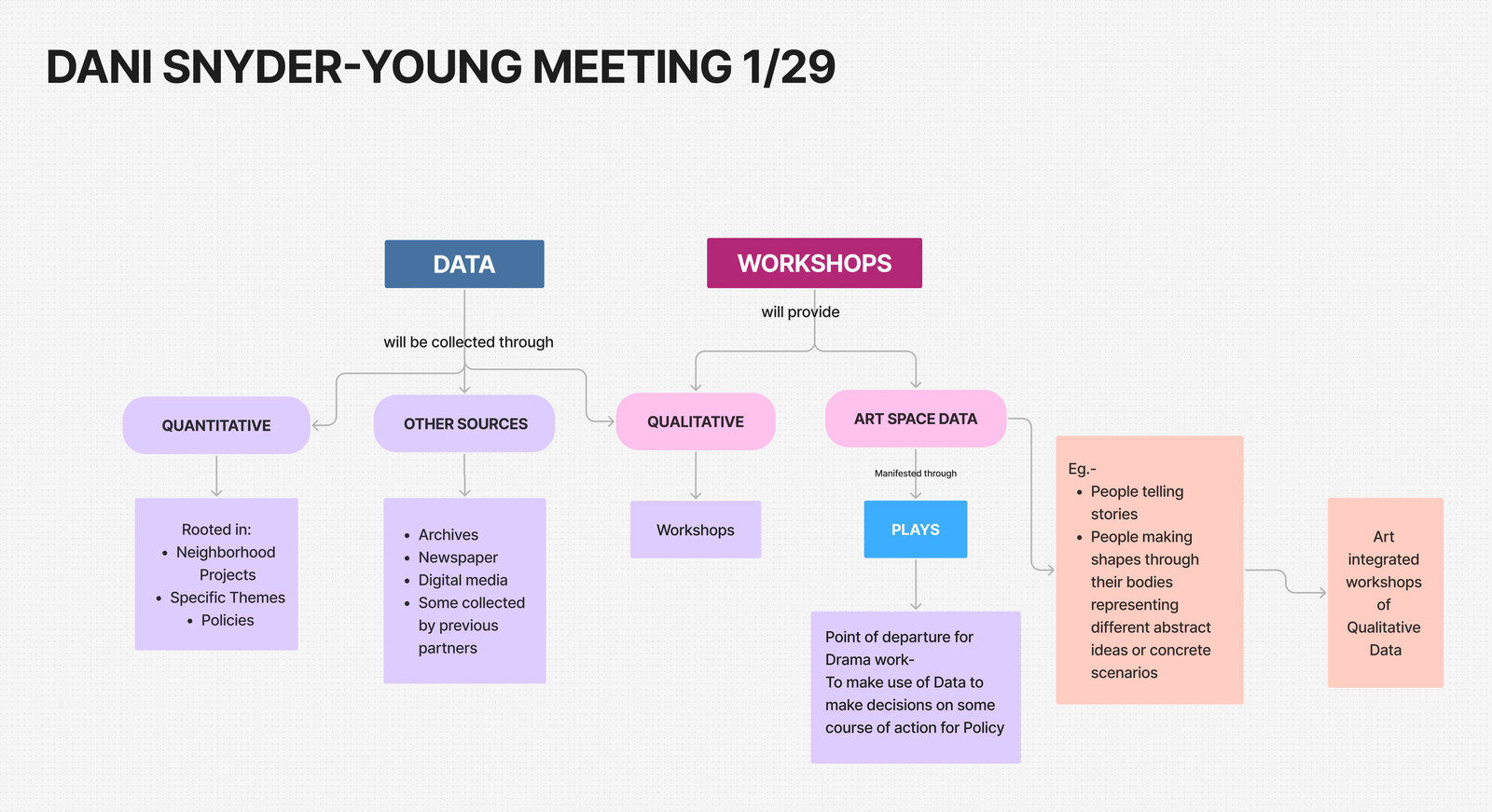
Before designing the toolkit, we worked with Dani to map how different kinds of data, quantitative, qualitative, and art-space, flow toward policy action through performance. This became the foundation of our design: our toolkit had to produce stories, observations, and embodied insights that Civic Data Theatre could use as a point of departure for drama work.
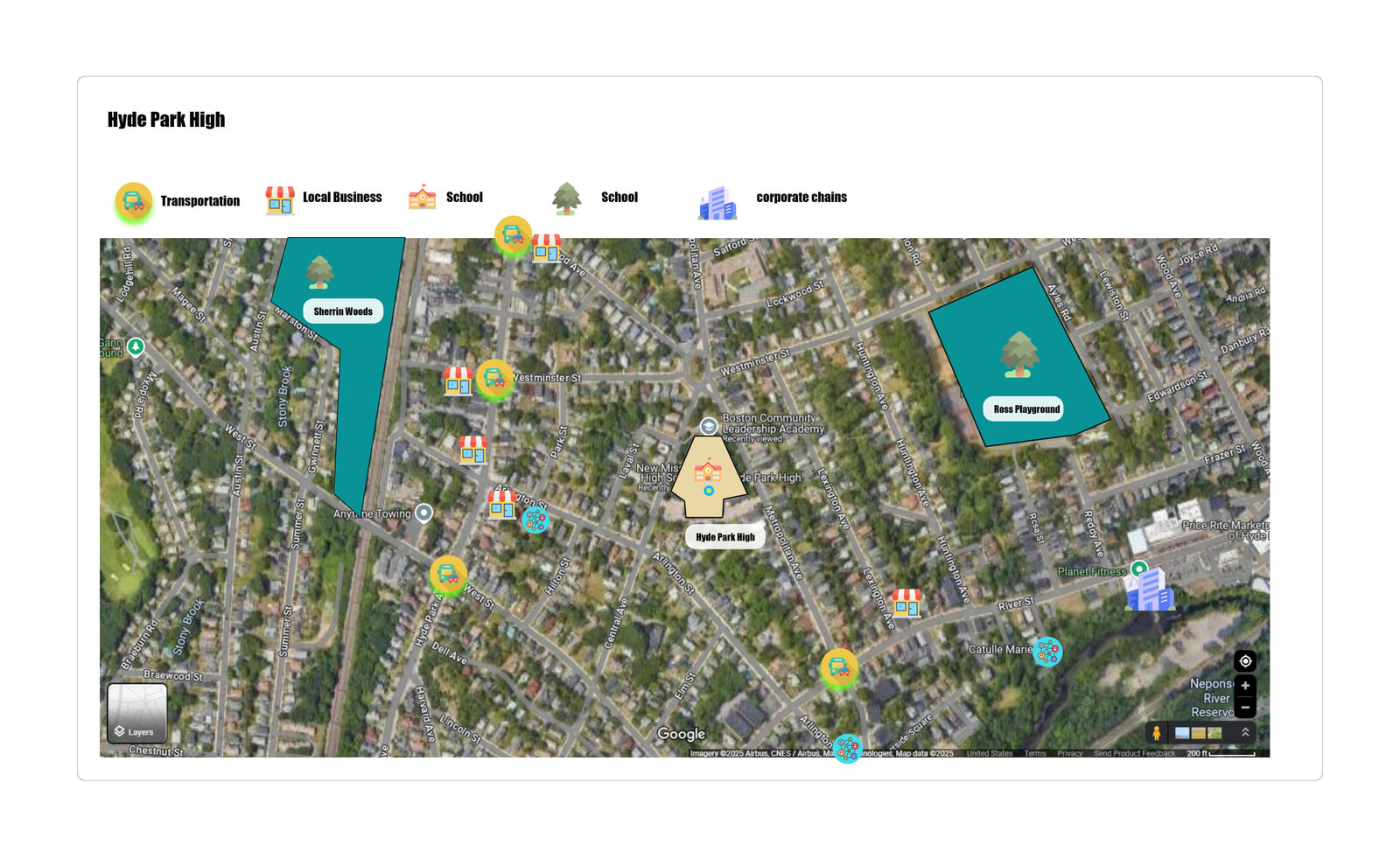
Initial framework: a neighborhood mapping activity overlaid on Hyde Park, with sticker categories for transportation, local businesses, schools, parks, and corporate chains.
Project Evolution
Our original framework was more ambitious. It combined a neighborhood mapping activity, a seed-type identification system, and parallel tracks for teens versus elders and neighborhood foraging versus established sites.
When we prototyped this, the cognitive load was too high. Participants couldn't identify plants, place them on a map, and answer reflective prompts in a single session. We made a hard decision: drop the mapping component entirely and refocus the prototype solely on the seed collection framework, allowing it to stand on its own as a simple, grounded tool for gathering qualitative data from children and teenagers in a creative way.
An Early Framework
Before designing the final toolkit, we developed a three-stage conversation framework as an early iteration. It mapped out how a workshop might flow: from outreach and survey, to facilitated dialogue, to structured group reflection.
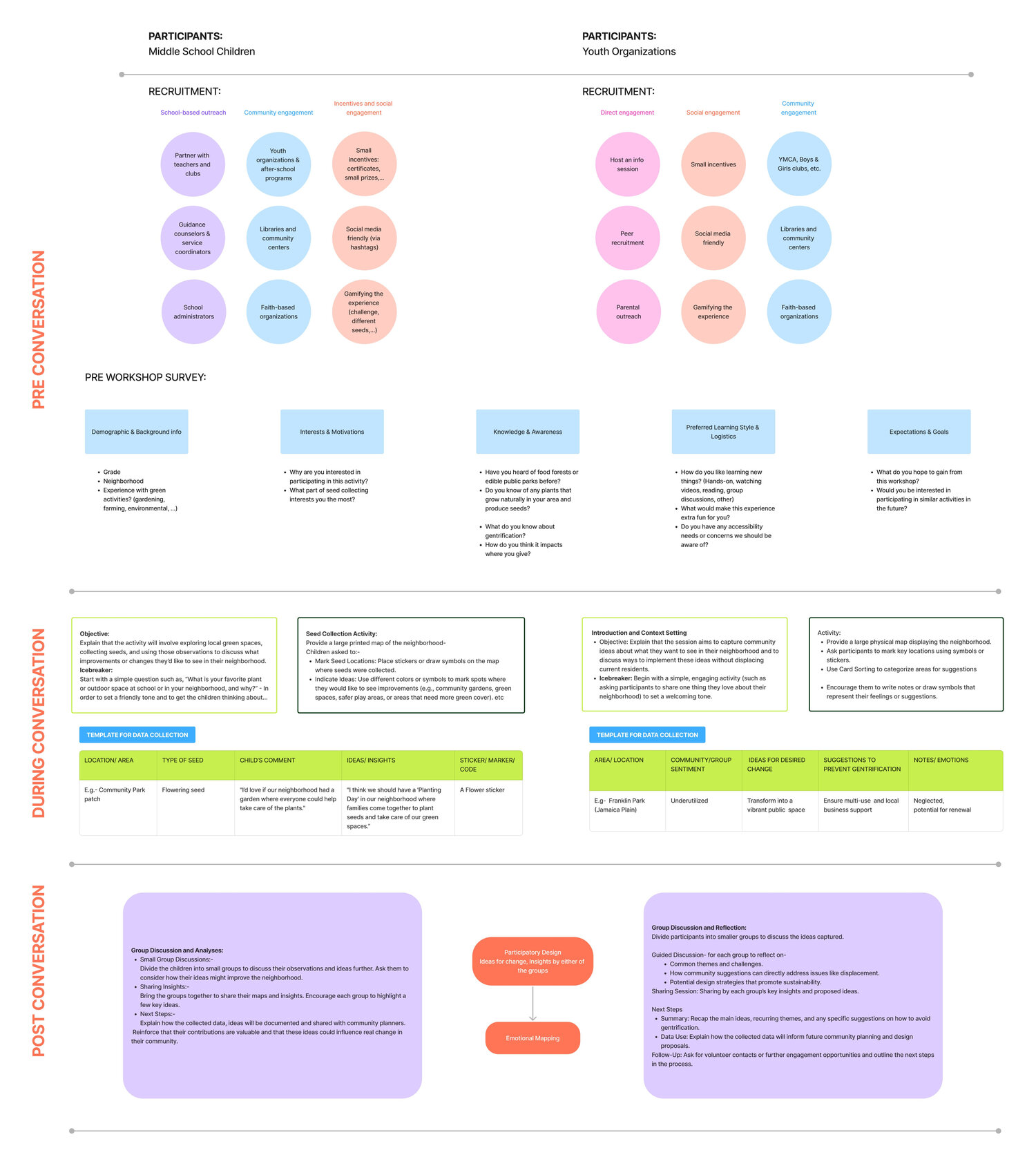
An early three-stage framework: Pre, During, and Post Conversation. Later replaced by a new framework and the Sow & Tell card-based game.
Outreach to high school students through schools, libraries, youth organizations, and faith-based groups. A short pre-workshop survey would capture demographics, interests, and awareness of green spaces and gentrification.
Students would explore local green spaces, collect seeds, and reflect on changes in their neighborhood, guided by a data collection template tracking location, seed type, and insights.
Facilitators would run small-group discussions and synthesize findings for community planners, capturing personal connections to plants, cultural memory, and shared themes.
In practice, this blueprint carried too much cognitive load for a single session. We refocused: a new, lighter framework and a self-contained card game, plant ID cards, action cards, and a laser-cut seed container, became the actual delivered prototype.
Refined Framework
We rebuilt the framework around a simpler arc, from setup to discussion, and paired it with a facilitator guide that supports real-time note-taking during the seed collection conversation.
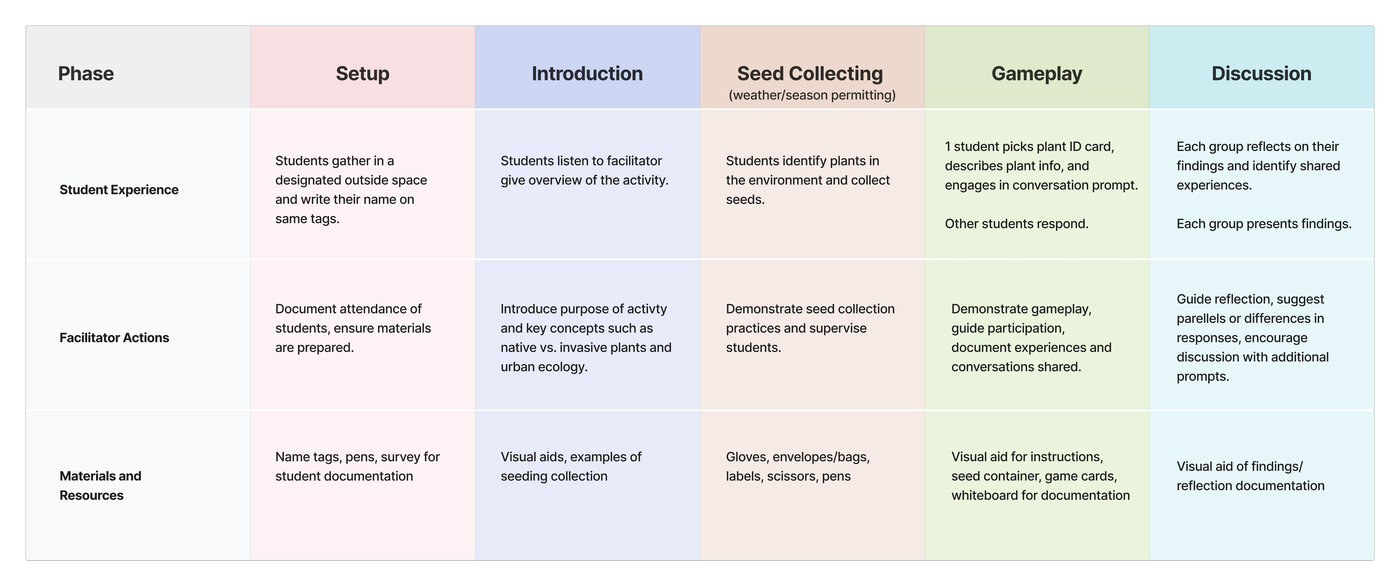
The updated framework: a five-phase flow from setup to discussion, with parallel rows for student experience, facilitator actions, and materials.
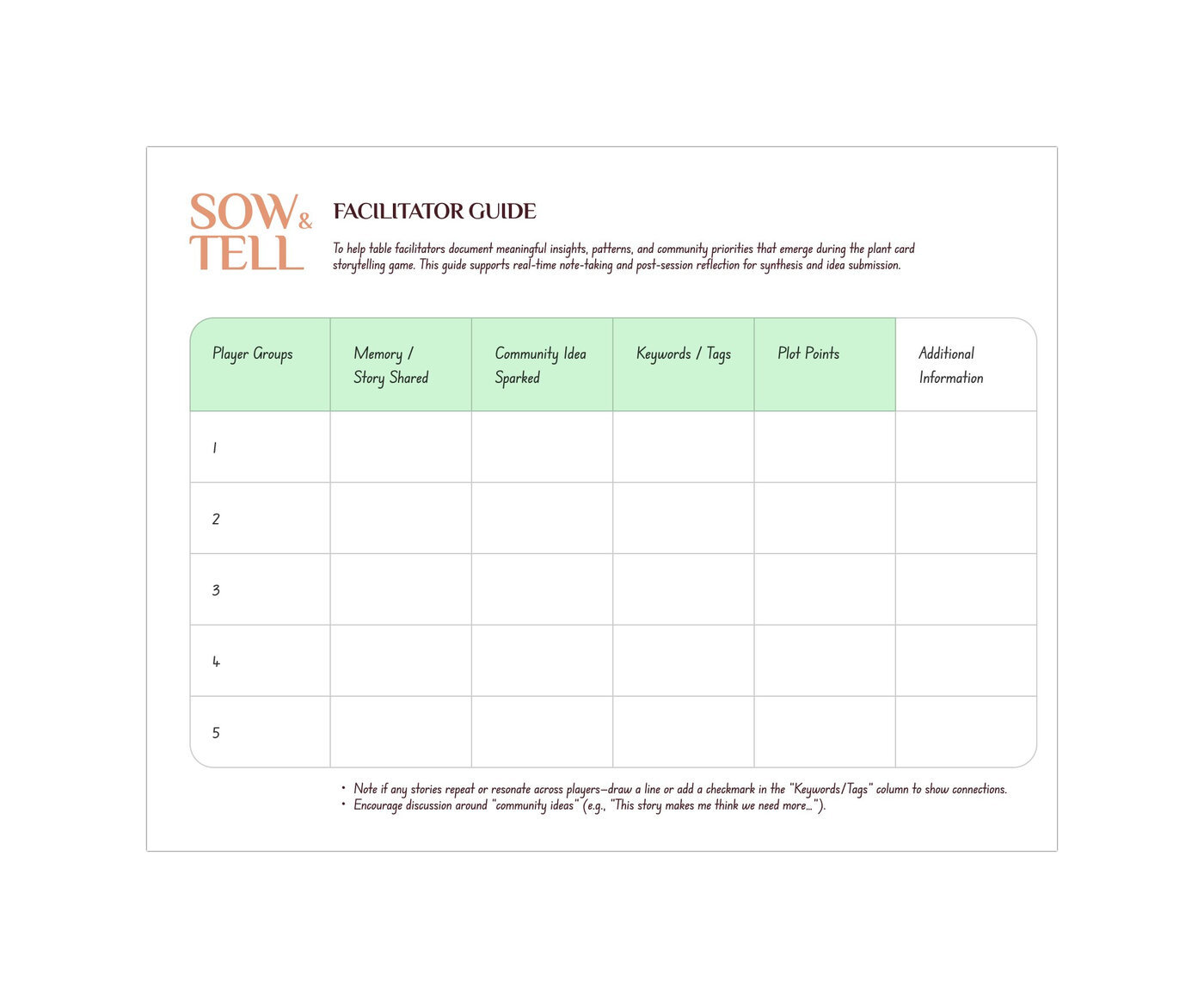
The facilitator guide: a printed worksheet that helps table facilitators capture stories, themes, and community ideas in real time.
The Toolkit
"Match seeds to plants, swap stories, and reflect on how green space shapes our communities. It's part nature walk, part neighborhood dialogue."
The final toolkit includes:
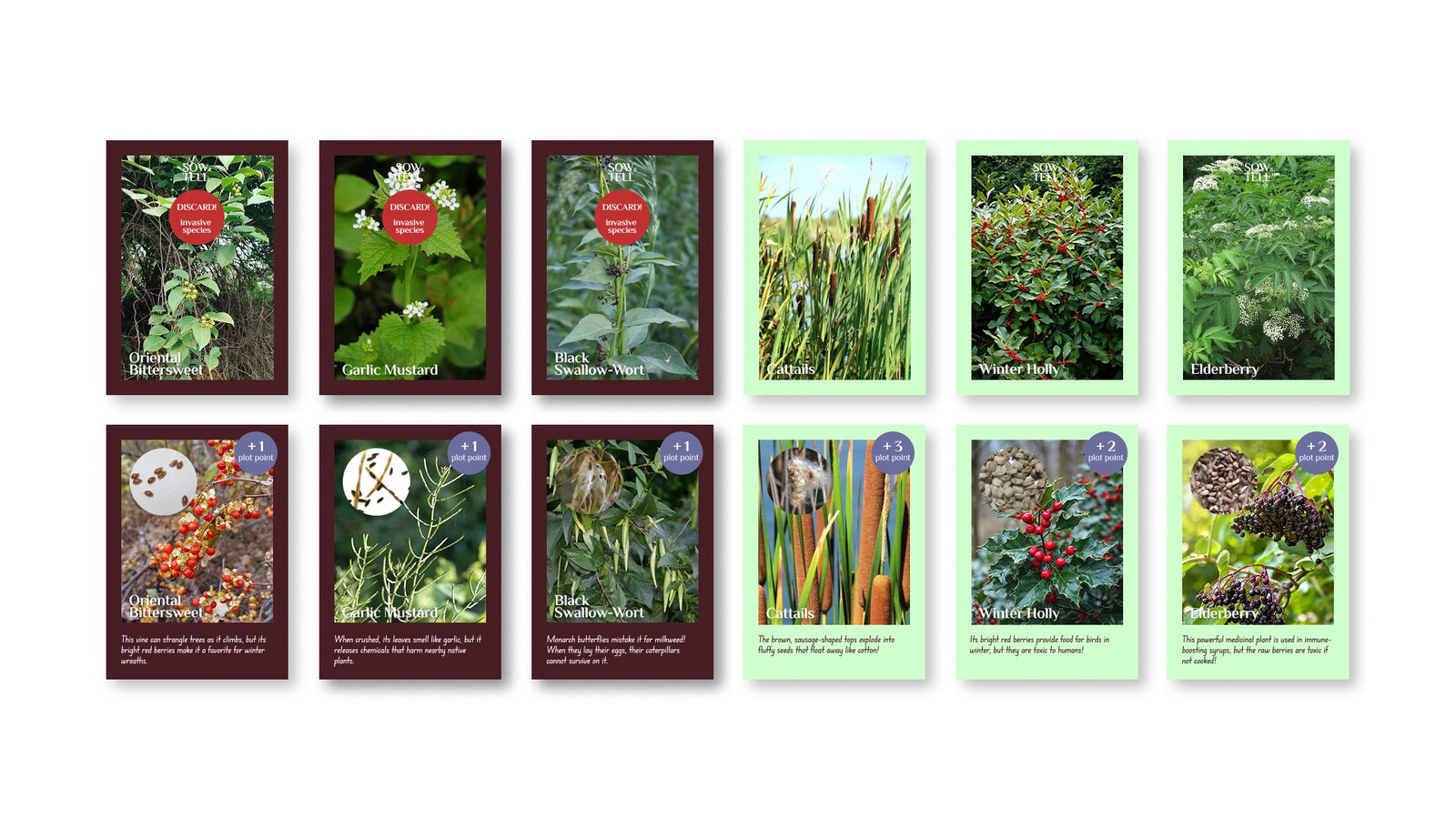
Plant ID cards, invasive species (red borders) and shrubs (green borders).
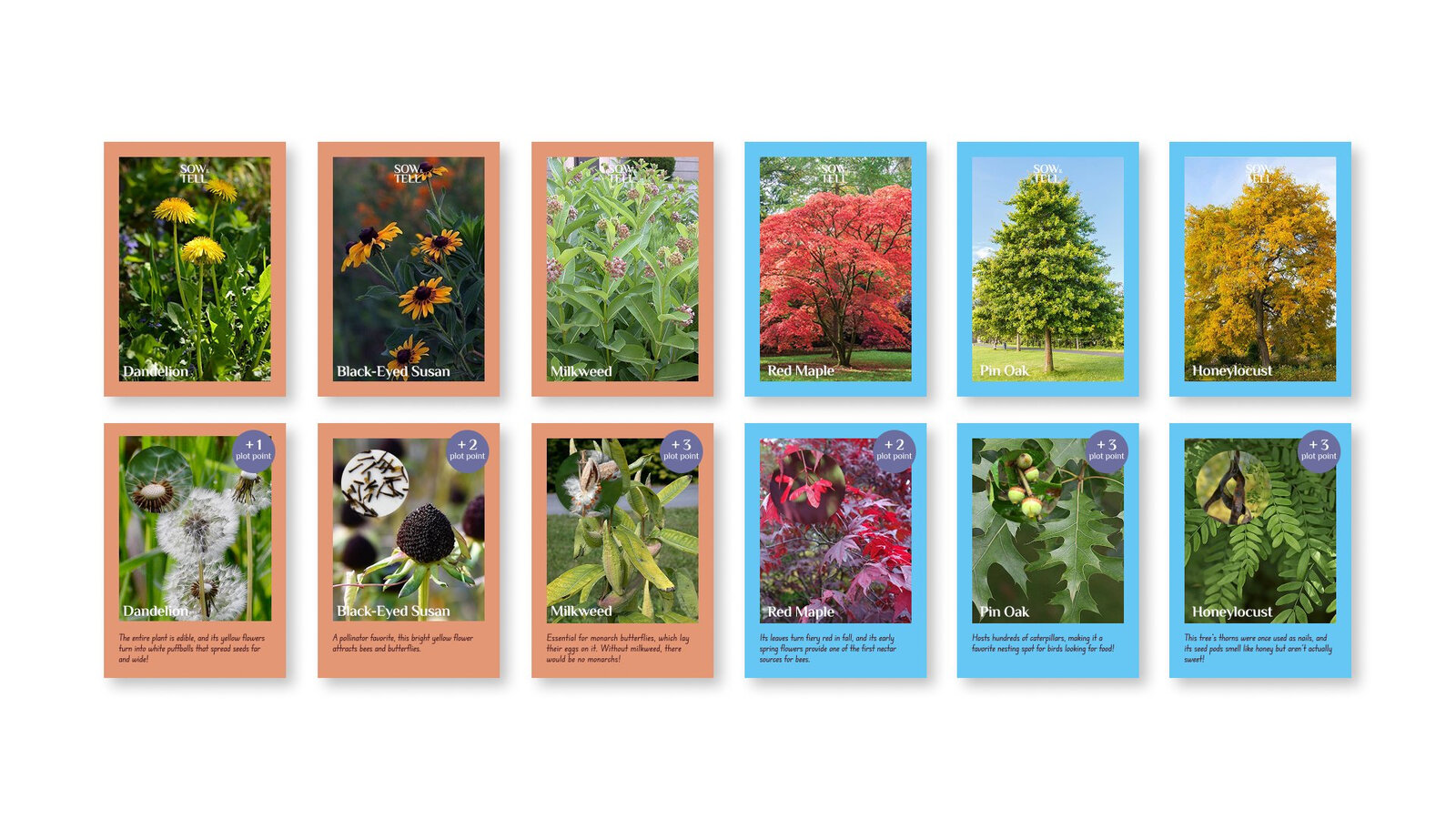
Plant ID cards, wildflowers (orange borders) and trees (blue borders).

Bonus Blooms cards and action prompts that guide each round of conversation.
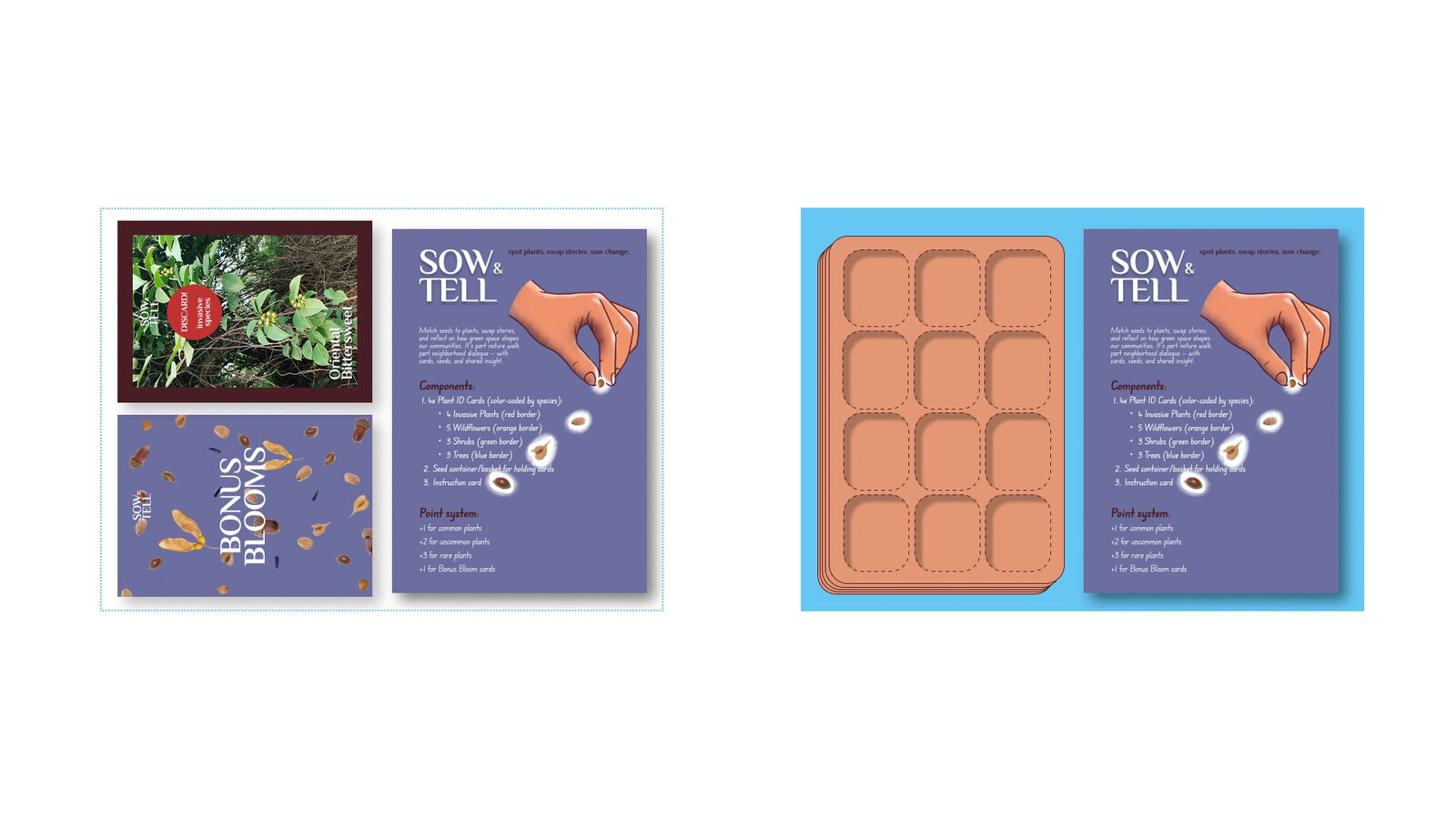
The full kit, plant cards, Bonus Blooms, instruction card, and the laser-cut seed container.
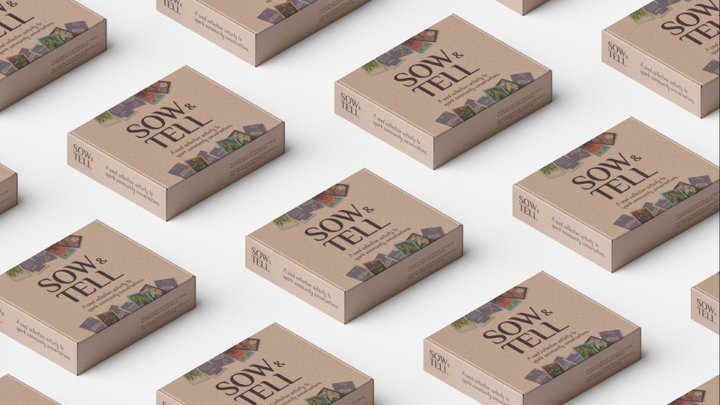
Packaged as a compact, portable box, a handy way to carry the seeds collected during the activity.
Testing
We tested the toolkit in two pilot rounds. The first used 12 plot points and 5 cards; the second tightened to 5 plot points and 3 cards. Across both rounds, the cards surfaced exactly the kinds of stories we hoped for, and also surfaced where the toolkit needed work.
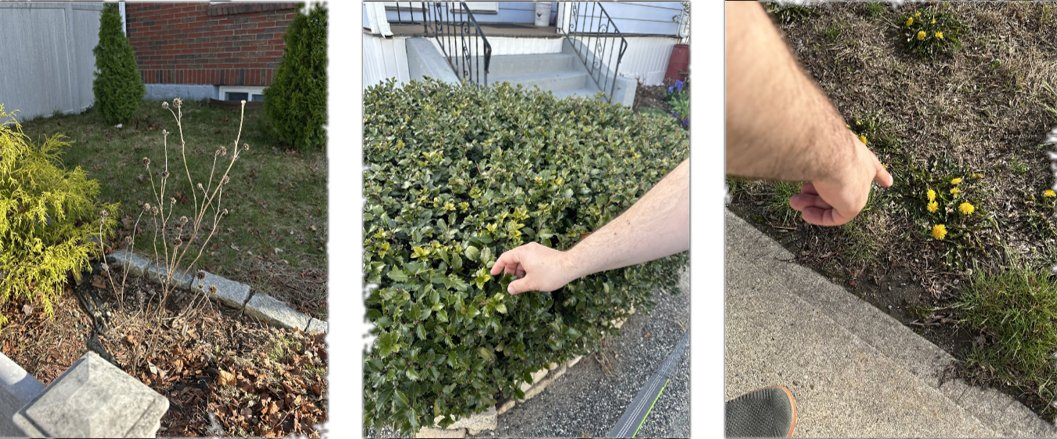
Out in the neighborhood: participants identifying plants and collecting seeds.
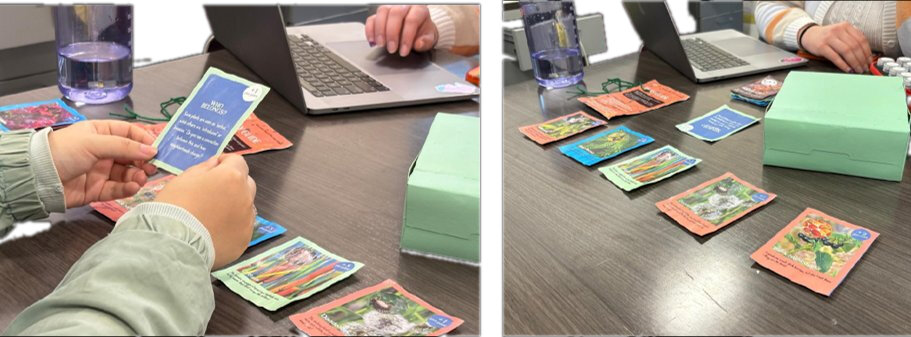
Indoor pilot session: testing the card mechanics and conversation prompts.
The most valuable insight came from a participant who was new to Boston, who could only recognize about 5 of the 12 plants. They surfaced a critical requirement:
Reflections
Sow & Tell shifted how I think about designing with, rather than for, young people. The right doorway matters more than the destination: asking teenagers about gentrification directly produces silence, but asking about a plant that disappeared from their block produces stories that carry real political and emotional weight.
If I ran this again, I'd test with actual high school students earlier. We did our pilots with adults because of timeline, and the gap between intended and tested users shaped our findings. I'd also revisit the mapping component we dropped, not for the first version, but as a Phase 2 layer once the core conversation is established.